

Private Label Cold Pressed Oil Manufacturer in Dehradun
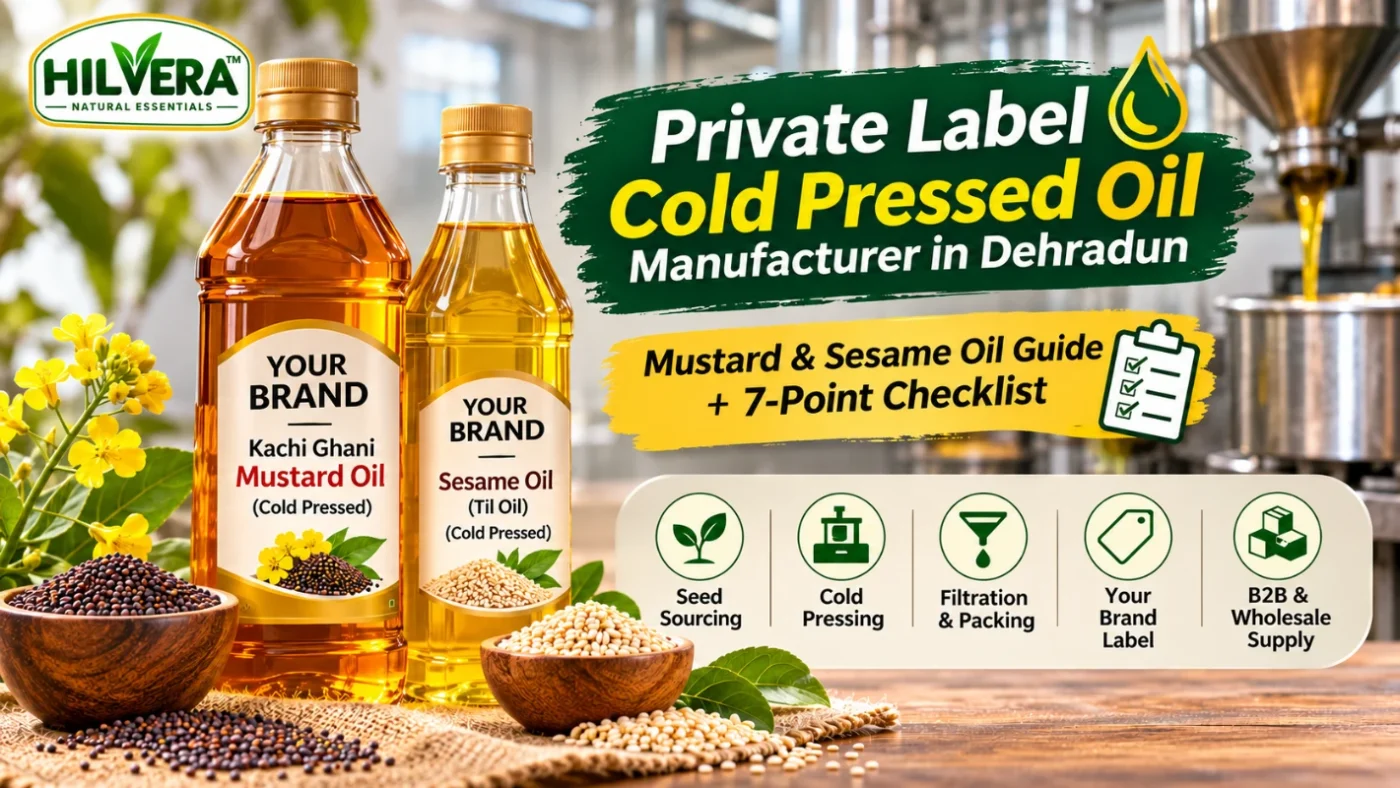
Have you ever picked up a bottle of kachi ghani mustard oil and thought, “I would love to sell oil like this under my own brand”? Good news: you do not need to build an oil plant to do it. You can work with a private label cold pressed oil manufacturer in Dehradun. The manufacturer makes and packs the oil. Your brand name goes on the bottle.
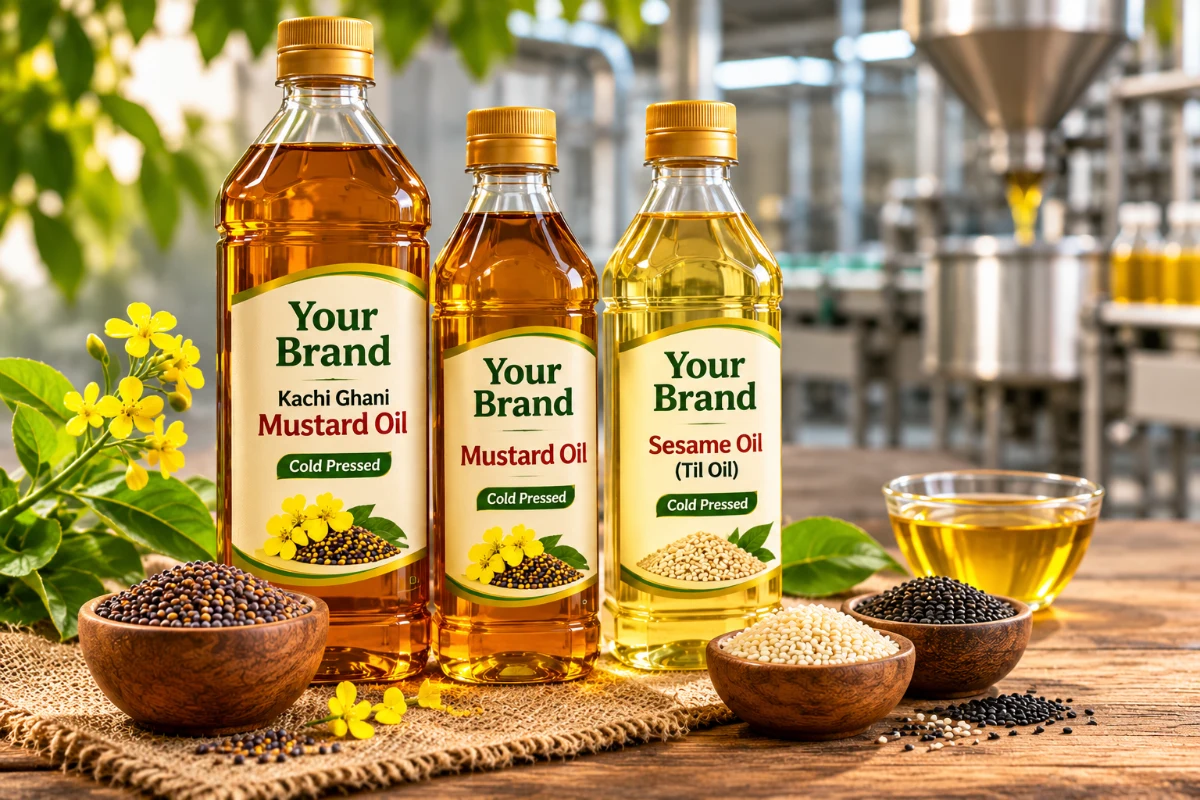
This guide explains everything in simple words. You will learn how private label oil works, what to ask before you place an order, why packaging and labels matter so much for oil, and a 7-point checklist for choosing the right manufacturer. We focus on cold pressed mustard oil and cold pressed sesame oil.
The Quick Version
- Private label oil means oil made by a manufacturer and sold under your brand name.
- You focus on your brand, your customers and your sales.
- The manufacturer focuses on making, filtering and packing the oil.
- Oil is a liquid, so packaging, leaks and storage matter more than they do for dry foods.
- Food labels and FSSAI rules must be right before you print your packaging.
- Always check a sample for colour, aroma and taste before ordering in bulk.
What Is Private Label Oil, in Simple Words?
Imagine you love a dish from a restaurant. You ask the kitchen to cook it for you, and then you sell it in your own shop under your own name. You did not build the kitchen. You only brought the idea, the brand and the customers.
Private label oil works the same way:
- The manufacturer makes the oil and packs it.
- You, the brand owner, choose the name, logo, bottle style and pack design.
- You and your distributors take care of selling.
Exactly who does what depends on the agreement you make. That is why it is a good idea to write everything down before work starts.
Private Label, White Label and Contract Manufacturing: What Is the Difference?
People often mix these up, and the terms can overlap. A simple way to remember them:
- Private label: a product made for your brand, usually to specifications you agree on, with your own packaging.
- White label: the manufacturer already has a ready product, and different businesses put their own brand on it.
- Contract manufacturing: a wider term. A manufacturer makes goods for you as per agreed specifications, quantities and responsibilities.
Before you begin, write down the product details, who owns what, who handles packaging, and who is responsible for rules and licences.
What Is Cold Pressed Kachi Ghani Oil?
Cold pressed oil is made by pressing seeds mechanically to get the oil out, instead of using chemical solvents. Kachi ghani is the traditional Indian name linked with this style of pressing, especially for mustard oil.
A small but important point: if you plan to write “cold pressed” or “kachi ghani” on your pack, make sure it truly describes how the oil is made. Ask your manufacturer to explain the process clearly, so your label tells the truth.
Cold Pressed Mustard Oil (Kachi Ghani)
Mustard oil is popular across north and east India. It is known for its strong aroma and sharp, pungent taste, and it is used in everyday cooking, pickles and many regional dishes.
Questions worth asking your manufacturer:
- Which mustard seeds are used, and where do they come from?
- How are the seeds cleaned before pressing?
- How is the oil pressed, filtered and stored?
- How do you keep every batch consistent?
Cold Pressed Sesame Oil (Til Oil)
Sesame oil comes from sesame seeds. It is known for its mild, nutty aroma and is used in many traditional kitchens.
When you plan a private label sesame oil, ask about:
- Seed quality and sourcing.
- The pressing and filtering method.
- Which packaging works best for it.
- Batch records and testing.
Aroma and taste are personal, and they can vary a little from batch to batch. That is why checking a sample yourself is so important.
Why Do People Start Their Own Oil Brand?
1. You can build your own brand
You choose the name, the look and the story, without owning an oil plant.
2. You can focus on selling
Instead of managing machines, you spend your time finding customers, building shop and distributor relationships and growing the brand.
3. You can start with one product and grow
Many brands begin with mustard oil, and later add sesame oil or other products, depending on demand and what the manufacturer can make.
4. You can plan your money better
With private label, you can talk about quantities, packaging costs and prices before you commit. That is easier to plan than setting up a whole facility.
Who Is Private Label Oil For?
- First-time entrepreneurs who want to start an edible oil brand.
- Distributors and wholesalers who want their own brand.
- Retailers and supermarkets who want a store brand.
- Online and D2C sellers building a food or grocery brand.
- Hotels, caterers and institutions that need regular supply.
How Does Private Label Cold Pressed Oil Manufacturing Work? (Step by Step)
Every project is a little different, but most follow these six steps.
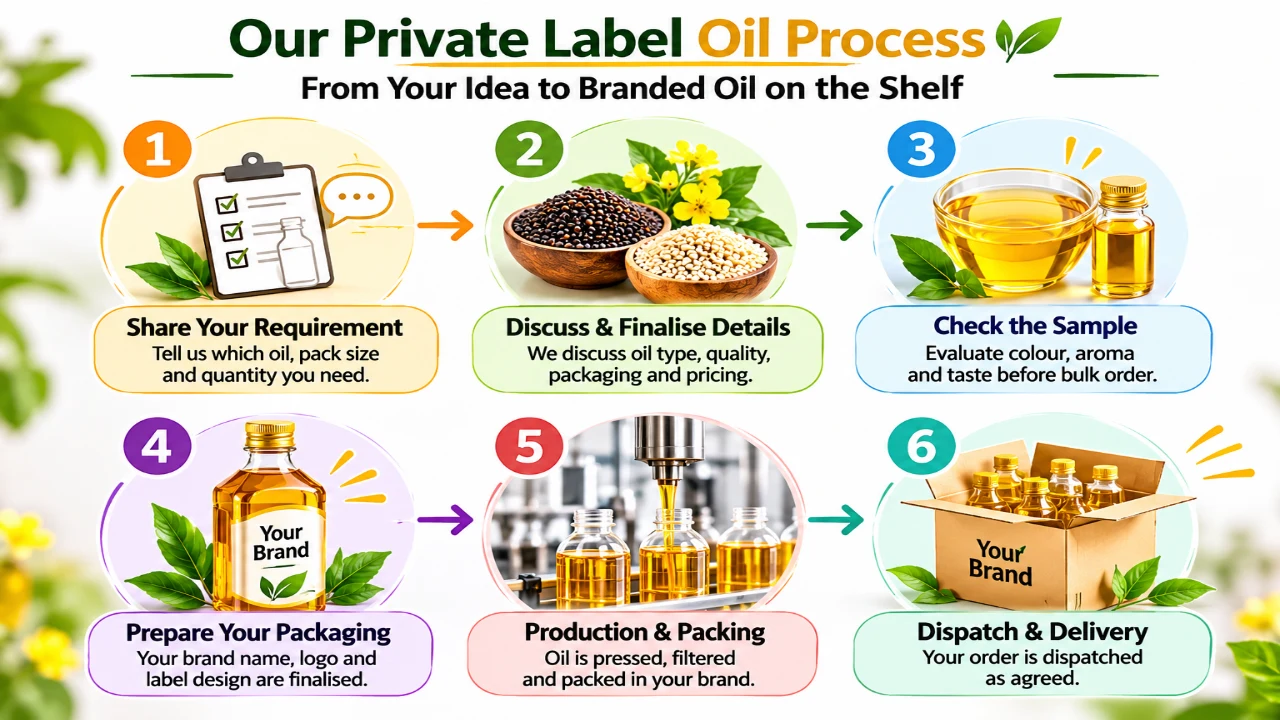
- Share your requirement. Tell us which oil you want, pack types, the quantity you expect and where you plan to sell.
- Discuss and finalise the details. We talk about the oil, quality expectations, packaging, pricing, minimum order quantity, production time and payment terms.
- Check the sample. Look at the colour and clarity, smell it and taste it in your own cooking. If you want lab testing, discuss that separately and clearly.
- Prepare your packaging. Your brand name, logo and design are finalised, together with the label details the law requires. Check these before printing in bulk.
- Production and packing. The oil is made and packed according to what you agreed.
- Dispatch and delivery. Your order is documented and sent as agreed, and you start selling.
Packaging Matters More for Oil
A bag of atta is easy to pack. Oil is a different story. It is a liquid, it can leak, and things like light, air and heat can affect it over time. Good packaging protects the oil and also tells your customer that your brand is serious.
1. Choose the right pack type
Depending on your product and market, you may consider food-grade PET bottles, glass bottles or HDPE containers. Always check that the material is suitable for the oil and for how long it will sit on the shelf.
2. Decide your pack sizes
Think about who will buy: households, shops, hotels or distributors. The sizes you can get depend on the manufacturer’s packing set-up, so ask what is available before designing your label.
3. Think about light and air
Packaging that protects the oil from light and air can help it stay in good condition. Ask your manufacturer what they recommend for your oil.
4. Test for leaks
Caps, seals and outer cartons should survive transport. A leaking bottle hurts your brand and your relationship with shops very quickly.
5. Plan storage
Agree on storage instructions and stock rotation with your manufacturer, and pass them on to your distributors.
FSSAI Rules and Food Labels for Private Label Oil
In India, food businesses must follow food safety rules. Which licence or registration you need depends on what your business actually does. The manufacturer, the packer and the brand owner may each have their own responsibilities.
What usually goes on an oil label
Depending on the product and the rules at that time, a retail oil pack may need things like:
- Brand name and product name.
- The right oil name or category.
- Net quantity.
- Ingredients and nutrition information, where applicable.
- Manufacturer, packer or marketer name and address, as applicable.
- FSSAI logo and licence number.
- Batch or lot number, packing date and best-before information.
- MRP and consumer care details.
- Storage instructions, where required.
Please treat this as a helpful checklist, not the full legal text. Label rules change from time to time. FSSAI brings in labelling amendments with a fixed yearly enforcement date of 1 July. Before printing, check the latest rules on the FSSAI website, including its labelling and display amendments page, and Legal Metrology requirements for packaged goods. A food-licensing consultant can double-check your artwork.
An important rule for mustard oil
Mustard oil has a special rule. FSSAI has prohibited blending mustard oil with other edible oils to make multi-source edible vegetable oils, effective from 8 June 2021. If you plan a mustard oil product, make sure your product details, manufacturing agreement and label wording follow the current rules.
7-Point Checklist: How to Choose a Private Label Cold Pressed Oil Manufacturer in Dehradun
Choosing your manufacturer is the biggest decision you will make. Ask these seven questions before you sign anything.
| # | Ask this | Why it matters |
|---|---|---|
| 1 | Do they hold a valid FSSAI licence that covers this activity? | It shows they are authorised to make the product you want. |
| 2 | Where do the seeds come from, and how are they checked? | Good seeds are the starting point of good oil and a consistent product. |
| 3 | How is the oil pressed, filtered and stored? | It helps you understand how your oil is made and handled. |
| 4 | Can I see samples and testing records? | You can judge the oil yourself and see what quality checks exist. |
| 5 | What packaging is available, and how do they prevent leaks? | Packaging protects the oil in storage and transport. |
| 6 | What are the minimum order quantity, production capacity and delivery time? | It tells you if they can really meet your needs. |
| 7 | Will everything be written down clearly? | Written details avoid confusion about prices, responsibilities and delivery. |
Common Mistakes New Oil Brands Make
- Picking the manufacturer on price alone. Look at the whole package: oil, packaging, supply and support.
- Skipping the sample. Check colour, aroma and taste before approving bulk production.
- Ignoring the rules. Learn about licences, product standards and labelling before you launch.
- Printing packaging too early. Finalise the product details and label content first. Reprinting thousands of bottles is expensive.
- Not writing down the agreement. Put product details, prices, quantities, responsibilities and delivery terms on paper.
- Starting with no sales plan. Decide who your customers are, where you will sell and what price you will charge before you order a big quantity.
Why Choose a Private Label Cold Pressed Oil Manufacturer in Dehradun?
Dehradun is a good base for serving Uttarakhand, Garhwal and nearby north Indian markets. When your manufacturer is close, it is easier to talk about the product, check samples, plan packaging and visit the facility.
Location is only one part of the story, though. Quality, rule-following, packaging support and honest communication matter just as much.
Why Upfront Enterprise?
Upfront Enterprise is a food manufacturing, packaging and marketing business based in Dehradun, Uttarakhand. We also run our own consumer brands, Kathait Gold™ and Hilvera™, which are separate brands under Upfront Enterprise. So we know both sides of the business: making a product and selling it to real customers.
Our cold pressed edible oil focus includes:
- Cold pressed mustard oil (kachi ghani).
- Cold pressed sesame oil (til oil).
If you want to start a private label project, tell us the oil you want, your packaging ideas, the quantity you expect and your target market. Availability and terms depend on the product details, production capacity and what we both agree.
Where to Find Us
Corporate Office:
Upfront Enterprise
58, Ring Road, Jagriti Vihar, Danda Dharampur, Upper Nathanpur, Dehradun, Uttarakhand – 248014, India.
Manufacturing Unit:
Kathait Gold Manufacturing Unit
Ward No. 100, Gujronwali Road, Shree Krishna Vihar, Nathuawala, Chaktonwala Grant, Dehradun, Uttarakhand – 248008, India.
FSSAI Licence Number: 12625005000533
Frequently Asked Questions
What is private label cold pressed oil manufacturing?
It is when a manufacturer makes and packs cold pressed oil for another business, which sells it under its own brand name. The details depend on the rules and on what you agree together.
Can I start a mustard oil brand without owning an oil mill?
Yes. You can work with a properly licensed manufacturer under a private label or contract manufacturing arrangement. Just make sure the responsibilities of both sides are clear in writing.
Can I sell sesame oil under my own brand?
Yes, if the manufacturer has the right processing set-up and the required licence for it.
What is the difference between kachi ghani and cold pressed mustard oil?
Kachi ghani is the traditional name linked with pressing mustard oil. Cold pressed describes pressing the seeds mechanically, without chemical solvents. They are closely related, but do not assume they mean exactly the same thing. Check how your oil is actually made, and describe it honestly on your label.
What is the minimum order quantity?
It depends on the oil, the packaging and the production plan. Ask for the actual minimum order quantity before you commit.
What packaging options are available?
Options may include food-grade PET bottles, glass bottles or HDPE containers, depending on the manufacturer’s set-up. Confirm the pack sizes and the material before finalising your design.
Do I need my own FSSAI licence as a brand owner?
Every food business needs the registration or licence that matches what it does. As a brand owner, check your own obligations instead of relying only on the manufacturer’s licence. A licensing consultant can tell you what applies to you.
What documents should I ask the manufacturer for?
Depending on your arrangement, ask for FSSAI licence details, product specifications, lab reports where available, batch records, packaging information and a written agreement.
Can I visit the manufacturing facility?
Yes, please contact us to ask about arranging a visit to our facility in Dehradun.
How do I enquire about private label mustard or sesame oil?
Send us the oil you want, your pack ideas, your target market and a rough quantity. That is enough to start the conversation.
Ready to Start Your Own Cold Pressed Oil Brand?
You do not need to have every answer today. Start with a clear idea, tell us about it, and we will help you take the next step.
- Email: info@hilvera.in
- Call / WhatsApp: +91 93899 23509
- Website: hilvera.in | kathaitgold.com
Your Brand. Your Packaging. Manufacturing Support from Upfront Enterprise.
Upfront Enterprise | FSSAI License No. 12625005000533