

What Is Chakki Fresh Atta?
In virtually every Indian household, the aroma of puffed, golden rotis on a hot tawa signals comfort, nourishment, and family tradition. When grocery shopping, almost every shopper encounters the familiar term Chakki Fresh Atta (चक्की फ्रेश आटा). But what does this phrase actually mean beyond marketing slogans? How does genuine chakki flour differ from commercial packaged flour, and why do rotis made from one stay soft for hours while another turns dry, chewy, or cardboard-like?
Historically, an atta chakki referred to a local neighborhood stone mill where whole wheat grains were ground between two heavy rotating stones. In Indian food regulations, the Food Safety and Standards Authority of India (FSSAI) defines whole wheat flour (atta) as the unrefined flour obtained by milling clean whole wheat without stripping its natural grain fractions.
However, not all flours labeled “chakki fresh” are produced equally today. Understanding wheat anatomy, milling technologies, and the distinction between commercial roller mills, traditional stone chakkis, and modern stoneless pulverizers is key to selecting nutritious flour for your daily meals.
The Anatomy of Wheat: What Should Be in Your Atta?
To understand real flour quality, one must look at the natural structure of a whole wheat grain (Triticum aestivum), which consists of three distinct biological layers:
- The Bran (Outer Husk ~14%): The protective outer shell packed with insoluble dietary fiber, B-complex vitamins, and essential minerals (iron, zinc, magnesium). It promotes healthy gut digestion, bowel regularity, and a feeling of fullness.
- The Endosperm (Middle Layer ~83%): The starchy carbohydrate core containing gluten-forming proteins (gliadin and glutenin). When refined alone, this layer becomes white flour or maida.
- The Wheat Germ (Nutrient Core ~3%): The nutrient-dense embryo of the seed containing healthy plant lipids (Vitamin E), polyunsaturated fatty acids, and phytonutrients.
True Chakki Fresh Atta grinds all three components together in their natural proportions. Nothing is sifted out, bleached, or discarded. In contrast, industrial commercial flours often extract the valuable germ and bran to sell as separate animal feeds or specialty oils, leaving consumers with a starch-heavy flour lacking essential nutrients.
How Wheat Is Milled: Roller Mills vs. Stone Chakkis vs. Stoneless Pulverizers
The machinery used to grind wheat plays a decisive role in flour texture, nutritional retention, and hygiene. Today, three primary milling systems exist in the market:
| Milling Feature | Commercial Roller Mill (Large Industrial Brands) | Traditional Stone Chakki (Local Neighborhood Mill) | Modern Air-Cooled Stoneless Pulverizer (Hilvera™ Standard) |
|---|---|---|---|
| Grinding Mechanism | High-speed corrugated steel rollers | Abrasive rotating stone discs | High-torque food-grade impact hammers |
| Operating Temperature | Moderate to high; multiple high-speed breaks | High friction heat (often >70°C–80°C) | Low, controlled temperature (<45°C with air cooling) |
| Nutrient Retention | Bran and germ separated; often partially blended back | Retains whole grain, but extreme heat can scorch germ proteins | 100% whole grain retention; natural vitamins and enzymes intact |
| Hygiene & Stone Dust | Industrial closed system; zero stone grit | Stone erosion introduces microscopic silica stone dust into flour | 100% stone-free, dust-free, and enclosed hygienic cyclone collection |
| Roti Texture | May feel rubbery or turn hard quickly after cooling | Warm and soft, but can feel gritty if chakki stones wear down | Naturally sweet, high water hydration, rotis stay soft for 6 to 8 hours |
While traditional stone chakkis played an essential historical role, abrasive stone wear is a real concern for family health. This is why forward-thinking food producers like Upfront Enterprise use air-cooled stoneless pulverizers. It captures the full whole-grain goodness of a chakki while guaranteeing zero stone dust and zero heat scorched nutrients.
Chakki Fresh Atta vs. Regular Packaged Atta
When scanning supermarket shelves, shoppers frequently ask: “Is Chakki Fresh Atta simply a marketing label for regular wheat flour?” The differences lie in processing, moisture retention, and additive formulation:
- Finer, Even Granulometry: Authentic chakki fresh flour has a slightly coarser, granular particle size compared to ultra-powdery roller-milled flour. This granulation allows water to penetrate deep into the bran particles during kneading.
- Superior Water Hydration: Whole-grain chakki flour absorbs more water per cup of flour. When baked, this trapped moisture turns to steam, puffing the roti into a balloon and keeping the inner crumb moist and pliable for hours.
- Zero Chemical Improvers: Many mass-produced “white” or “regular” flours use chemical whiteners (such as benzoyl peroxide or potassium bromate) to create an unnaturally pale, uniform look. Genuine chakki fresh flour has an earthy, creamy-golden appearance with visible reddish-brown bran flakes.
Is Chakki Fresh Atta Always 100% Whole Wheat?
Not necessarily. In commercial grocery retail, the term “Chakki Fresh” describes the milling style, not the mandatory purity of the grain.
Some budget commercial brands blend 10% to 20% refined flour (maida) into their flour mixes to reduce production costs and artificially increase puffing volume. To ensure you are feeding your family genuine whole-grain nutrition, always inspect the ingredient list on the back of the bag:
The Pure Ingredient Rule: The ingredient list should read strictly: “100% Whole Wheat” or “Whole Wheat Grains”. If the label mentions “Refined Wheat Flour”, “Fortified Starch”, or “Improvers”, it is not unadulterated whole wheat flour.
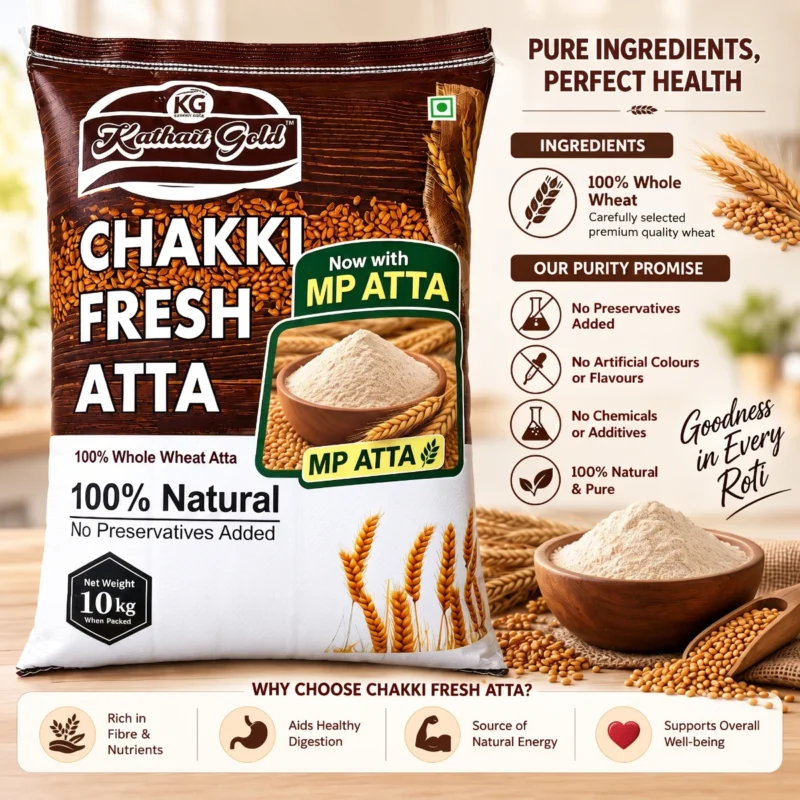
For example, Hilvera Chakki Fresh Atta is milled strictly from 100% single-origin whole wheat grains sourced from Madhya Pradesh with zero maida, zero bleaching agents, and zero preservatives.
A Practical Buyer’s Checklist: How to Choose Pure Atta
When selecting whole wheat flour for your kitchen, evaluate these six indicators on the package:
- Check the Wheat Source: Premium flours highlight the agricultural origin of their grain. High-protein grains grown in the rainfed black soil of Central India (such as MP Sharbati Wheat) are naturally sweeter, heavier, and produce exceptionally soft rotis.
- Look for Stoneless Milling Verification: Prefer flours milled in food-grade stoneless pulverizers over open stone grinders to ensure your rotis are completely free of microscopic stone dust.
- Confirm Dietary Fiber Content: Genuine whole wheat flour contains at least 10g to 11.5g of natural dietary fiber per 100g. If the fiber count is below 7g, significant bran has likely been extracted.
- Examine Packaging Integrity: Avoid paper or loosely woven sacks that allow ambient humidity to spoil the wheat germ. Choose multi-layer, moisture-barrier laminated bags that lock in mill freshness.
- Verify Manufacturer Credentials: Check for a clear physical factory address and a valid 14-digit FSSAI license number (e.g., FSSAI Lic. No. 12625005000533) rather than anonymous contract-repackers.
- Select Suitable Pack Sizes: Whole wheat flour containing natural wheat germ has a natural shelf life of 90 days. Choose 5kg or 10kg bags that match your family’s monthly consumption so your flour is always consumed fresh.
Culinary Science: How to Make Rotis That Stay Soft for 8+ Hours
Making soft, cloud-like chapatis that don’t dry out in lunchboxes is simple when you understand how whole-grain flour behaves:
- Use Lukewarm Water: Kneading with lukewarm water activates wheat proteins (glutenin and gliadin) faster, creating a smooth, elastic gluten matrix.
- Add Water Gradually: Whole wheat bran absorbs water slowly. Add water in three stages and knead for 4 to 5 minutes until the dough feels supple, soft, and non-sticky.
- The Non-Negotiable 20-Minute Rest: Always cover your kneaded dough with a damp cloth and let it rest for 15 to 20 minutes before rolling. This resting window allows the dry bran flakes to hydrate fully and relaxes the gluten strands, preventing stiff or rubbery flatbreads.
- Cook on a Preheated, Heavy Tawa: Cook on medium-high heat. Flip after 15–20 seconds when tiny bubbles form, cook the second side for 30–40 seconds until speckled, then place over direct flame for instant balloon puffing.
How to Store Fresh Atta at Home
Because unadulterated whole wheat flour contains active wheat germ oils without synthetic chemical stabilizers, follow these storage guidelines:
- Keep the unopened bag in a cool, dry pantry away from damp floors, direct sunlight, and hot cooking stoves.
- After opening, immediately transfer the flour into a clean, dry, airtight stainless-steel container or food-grade storage bin.
- Always use a clean, dry scoop. Introducing even a drop of water from wet hands can cause localized mold or weevil infestation.
- During humid monsoon seasons, place a few whole cloves or dried bay leaves in the container to act as natural organic insect repellents.
The Hilvera™ Purity Commitment
At our licensed milling facility in Nathuawala, Dehradun, Hilvera™ (by Upfront Enterprise) mills 100% pure whole wheat flour for families who demand uncompromised kitchen purity:
- Single-Origin MP Wheat: Sourced from selected Madhya Pradesh golden grains celebrated for natural sweetness and high protein.
- Precision Air-Cooled Pulverization: Milled at low operating temperatures to protect natural bran, fiber, and B-vitamins without stone grit.
- Zero Additives: Certified 100% whole grain with zero maida, zero bleaching agents, and zero chemical preservatives.
- FSSAI Certified Local Facility: Processed and packed under strict hygiene protocols under FSSAI License No. 12625005000533 and GSTIN: 05AKJPK8349P4ZB.
Manufacturing Facility: Ward No. 100, Gujronwali Road, Shree Krishna Vihar, Nathuawala, Dehradun, Uttarakhand – 248008
Corporate Office: 58, Ring Road, Jagriti Vihar, Danda Dharampur, Upper Nathanpur, Dehradun, Uttarakhand – 248014
Helpline / WhatsApp: +91 93899 23509 | Email: info@hilvera.in
Summary Verdict
Chakki Fresh Atta is far more than a familiar grocery phrase—it represents a commitment to whole-grain integrity, natural dietary fiber, and healthy family meals. By choosing flour that retains 100% of the wheat bran and germ, milled without abrasive stone friction or chemical bleaches, you ensure that every roti on your table delivers genuine nourishment, authentic taste, and long-lasting softness.