


Cold-Pressed Oils Guide
Kachi Ghani Mustard Oil vs Refined Oil: Which Is Healthier for Everyday Cooking?
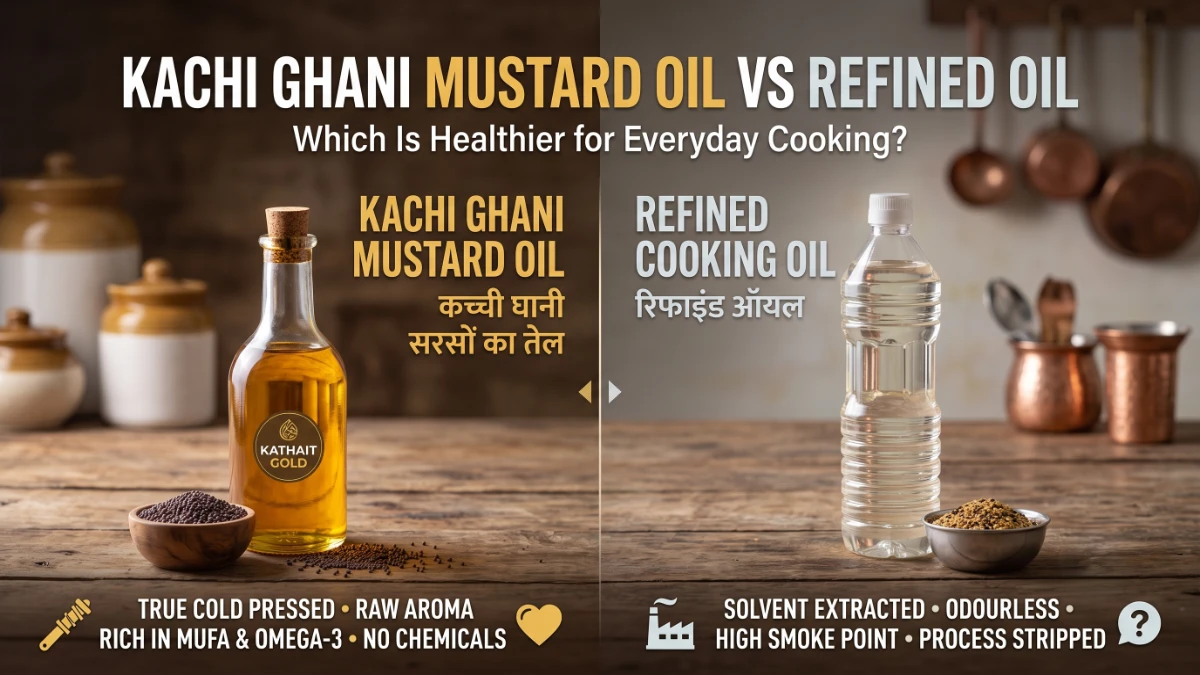
Kachi Ghani Mustard Oil vs Refined Oil: Which Is Healthier for Everyday Cooking?
Walk down any grocery aisle today and you will confront a striking contrast: on one side stand bottles of golden, aromatic, cold-pressed mustard oil; on the other, rows of crystal-clear, odorless refined oils. For generations, traditional Indian households trusted cold-pressed oils like Kachi Ghani mustard oil (कच्ची घानी सरसों का तेल) as the backbone of daily nourishment. However, the rise of modern industrial processing popularized refined vegetable oils under the promise of lightness and convenience.
As modern research re-examines industrial food processing, families across India are taking a closer look at what actually goes into their pans. Comparing cold pressed Kachi Ghani mustard oil and chemically refined cooking oil reveals fundamental differences in extraction, nutrient retention, kitchen performance, and long-term wellness.
What Is the Real Difference in Extraction? The Process Defines the Purity
The core distinction between cold-pressed oils and refined oils starts at the seed. How an oil is drawn from its botanical source determines whether its delicate bioactive compounds survive or are destroyed during production.
Kachi Ghani Mustard Oil: Gentle Mechanical Crushing
The term Kachi Ghani translates to cold-press extraction via traditional mechanical or wooden expellers. In this time-tested method, premium-grade mustard seeds are crushed slowly at low temperatures, consistently kept below 50°C. Because no external thermal energy is applied, friction heat remains minimal.
- Chemical-Free Processing: The oil is extracted purely through mechanical pressure, without the use of chemical solvents or synthetic catalysts.
- Preservation of Native Phytonutrients: Natural antioxidants, Vitamin E, plant sterols, and the signature compound Allyl Isothiocyanate (responsible for the pungent jhaanjh) remain fully intact.
- Natural Filtration: The extracted oil is clarified using simple sedimentation and cotton fabric filtration, preserving its authentic golden hue, viscosity, and raw aroma.
Refined Cooking Oil: High-Heat Industrial Extraction
Refined oils—commonly derived from soybean, sunflower, palm, corn, or low-grade seed blends—are engineered for maximum industrial yield, long shelf-life, and neutral flavor. Achieving this requires an intensive multi-stage chemical and thermal process.
- Solvent Extraction: Seeds are crushed and washed with petrochemical solvents, most commonly food-grade hexane, to draw out every residual droplet of fat.
- Neutralization: The crude oil is treated with sodium hydroxide (caustic soda) or other alkaline chemicals to strip away free fatty acids.
- Bleaching: To remove natural pigments and achieve an ultra-clear, pale color, the oil is passed through acid-activated clays or bleaching earth.
- High-Heat Deodorization: The oil is subjected to vacuum steam deodorization at temperatures exceeding 200°C to 240°C to strip out all volatile odors, tastes, and natural aromas.
While this process delivers an odorless liquid with extended shelf life, it strips the seed of its native micronutrients, fat-soluble vitamins, and beneficial plant compounds.
Nutritional Breakdown: Cold Pressed vs Refined Fats
Daily edible oil consumption accounts for a substantial portion of your family’s dietary fat intake. The composition of fatty acids—specifically the balance of Monounsaturated Fatty Acids (MUFA), Polyunsaturated Fatty Acids (PUFA), and saturated fats—plays a direct role in metabolic and cardiovascular wellness.
Fatty Acid Balance and Heart Health
Pure Kachi Ghani mustard oil is naturally rich in MUFA (approximately 60% to 65%), primarily oleic and erucic acids. MUFA-rich diets are widely recognized by cardiologists and nutritionists for supporting balanced blood lipid markers by helping maintain healthy HDL (good) cholesterol levels.
Furthermore, cold-pressed mustard oil provides a near-ideal ratio of Omega-3 (Alpha-Linolenic Acid) to Omega-6 (Linoleic Acid) fatty acids, roughly 1:1.2. In contrast, many mass-market refined oils are heavily skewed toward Omega-6 fats (sometimes exceeding 1:20), a dietary imbalance that public health researchers associate with systemic lifestyle inflammation.
The Hidden Concern: Trans-Fats and Thermal Degradation
When cooking oils are subjected to temperatures above 200°C during industrial refining, their molecular structure begins to alter. Repeated high-heat refining can generate trace trans-fatty acids and oxidation by-products. Traditional cold-pressed oils bypass this thermal degradation entirely, remaining clean and structurally uncompromised from press to bottle.
| Comparison Factor | Kachi Ghani Mustard Oil | Industrial Refined Oil |
|---|---|---|
| Extraction Method | Low-heat mechanical expeller crushing | Hexane chemical solvent extraction |
| Processing Temperatures | Below 50°C (True Cold-Pressed) | 200°C to 240°C (Steam Deodorization) |
| Chemical Reagents Used | None; 100% mechanical & physical | Hexane, caustic soda, bleaching earth |
| Predominant Fatty Acid | Monounsaturated Fatty Acids (MUFA) | Often Polyunsaturated (PUFA) or processed blends |
| Omega-3 to Omega-6 Balance | Balanced natural ratio (~1:1.2) | Often heavily skewed toward Omega-6 |
| Natural Micronutrients | Retains native Vitamin E, sterols, and antioxidants | Largely stripped; requires synthetic fortification |
| Aroma, Taste, and Color | Rich golden tint, sharp aroma, distinct taste | Pale or water-clear, odorless, neutral flavor |
Culinary Performance: Smoke Point, Tadka, and Stability
Indian cooking techniques differ substantially from Western culinary practices. Between flash tempering (tadka), deep frying pooris, and slow-simmering thick curries, an oil must remain thermally stable under intense kitchen heat.
High Smoke Point for Safe High-Heat Frying
One common myth is that unrefined cold-pressed oils cannot handle high heat. While delicate oils like extra virgin olive oil have lower thermal tolerance, pure mustard oil possesses a naturally high smoke point of approximately 250°C (482°F). This places it among the most heat-stable culinary fats available, safely above typical deep-frying and sautéing temperatures (170°C–190°C), minimizing the formation of harmful acrolein and toxic aldehydes.
Mastering the Traditional Tadka Technique
To enjoy the authentic flavor of cold-pressed mustard oil without overpowering your palate, culinary tradition offers a straightforward technique: heat the oil gently in your pan until a light, steady wisp of smoke rises. Turn off or lower the burner for 30 seconds to let the temperature stabilize slightly, then introduce your cumin seeds, mustard seeds, asafoetida, and ground spices. This brief tempering mellows raw sharpness into a rich, nutty, and savory base.
Natural Food Preservation
Mustard oil has served as the natural preserving medium in Indian homes for centuries. The natural Allyl Isothiocyanate present in cold-pressed mustard oil exhibits potent antimicrobial and antifungal properties, allowing traditional pickles (achaar) to remain fresh for months without a single drop of synthetic chemical preservative.
Regional Sourcing: Why Transparency Matters for Family Trust
A major vulnerability of mass-market commercial cooking oils is opacity. Bulk crude oil is frequently shipped across international shipping lanes in large holding vessels, stored in transit for months, and chemically refined far from the consumer. Traceability back to the original agricultural source is nearly impossible.
Choosing regional, traceable staples restores accountability to your daily plate. At our Kathait Gold manufacturing unit in Nathuawala, Dehradun, locally sourced mustard seeds undergo strict physical sorting, cleaning, and slow mechanical pressing under FSSAI-certified quality standards. Producing in small, carefully monitored batches ensures that the oil reaching your kitchen table retains its natural aroma, pure golden viscosity, and farm-fresh vitality.
Frequently Asked Questions
Can I replace refined oil with Kachi Ghani mustard oil for all daily cooking?
Yes. Pure cold-pressed mustard oil is fully suited for everyday cooking, including dal tadka, seasonal vegetable curries, dry roasts, and deep-frying. Its high smoke point and healthy monounsaturated fat composition make it a practical daily choice for family meals.
Why does pure Kachi Ghani mustard oil cause eyes to water slightly?
That familiar pungent vapor—known as jhaanjh—is caused by Allyl Isothiocyanate, an organic sulfur compound released when fresh mustard seeds are cold crushed. Far from being a flaw, this natural pungency is a traditional marker of unadulterated, unheated seed extraction.
How can I verify the purity of cold-pressed mustard oil at home?
Pour a small sample of mustard oil into a small glass bowl and place it in your refrigerator for a few hours. Pure mustard oil will remain completely liquid with a clear golden body. If the oil solidifies, separates into cloudy layers, or leaves a white waxy sediment, it may be blended with cheaper palm oils or liquid paraffin.
Does cold-pressed mustard oil contribute to bad cholesterol?
No. Real cold-pressed mustard oil is free from industrial trans-fatty acids and contains minimal saturated fat. Rich in monounsaturated fats (MUFA) and natural antioxidants like Vitamin E, it supports healthy vascular function when used as part of a balanced whole-food diet.